AI Strategic Advisor: The Natural Convergence of My Profiles
June 1, 2026
Return To All ArticlesIntroduction
Organizations are under enormous pressure to "do something with AI." Many are investing — sometimes heavily — without a clear diagnosis of what problem they're actually trying to solve. AI initiatives that start as proof-of-concepts die after weeks or months, having wasted thousands of dollars and, more importantly, the team's trust in the technology.
The issue is rarely the technology. It's the absence of strategy.
Advisor vs. Consultant
The distinction I draw is not semantic — it's fundamental.
A consultant arrives with a solution and looks for where to apply it. Their value is in execution: they bring a methodology, a tool, a framework, and they deploy it.
An advisor arrives with judgment and guides the decision. Their value lies in the criteria applied before execution — understanding the business deeply enough to know whether AI is actually the right answer, and if so, where and how.
In a market flooded with vendors selling generic AI solutions driven by FOMO, what organizations increasingly need is honest guidance: someone who can say "yes, this makes sense here" and equally, "no, this is not the right application for your context."
What "Strategic" Actually Means
The word "strategy" is overused to the point of losing meaning. Teams call their task list a strategy. Projects get labeled strategic without any clear direction.
Following Rumelt's definition, a real strategy has three components: a clear diagnosis of the challenge, a guiding policy that defines how to address it, and coherent actions that flow from that policy.
Applied to AI adoption, this means:
- Understanding the organization's actual processes and pain points before proposing any solution
- Defining where AI creates measurable value — and where it doesn't
- Designing coherent implementation with metrics, governance, and a realistic view of the cultural transformation required
Without this foundation, AI initiatives remain isolated, unmeasured, and disconnected from business outcomes.
The Convergence of My Profiles
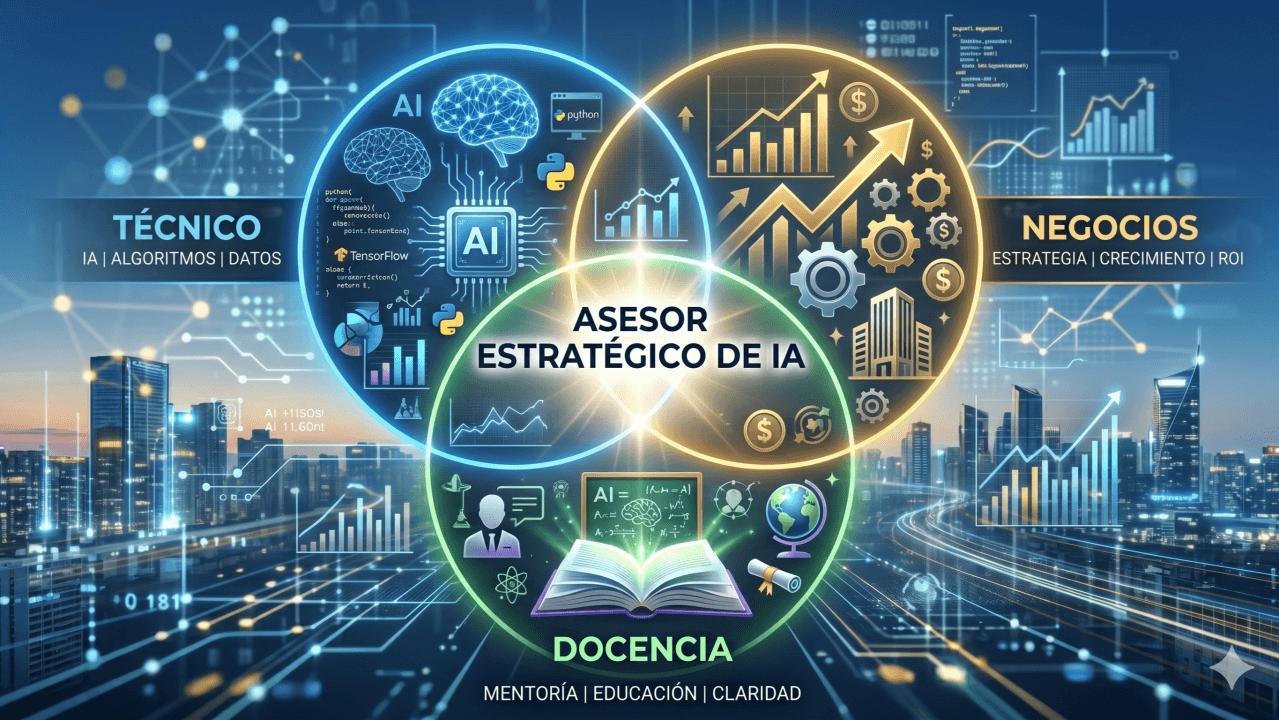
This positioning isn't a pivot — it's a convergence. Over the years I've built across three intersecting domains:
- Technical depth: AI engineering, systems engineering, research projects — I understand how these systems work at an implementation level
- Business perspective: MBA — I understand organizations, decisions, and trade-offs from a management lens
- Education: University instructor in AI applications — I know how to transfer complex concepts clearly and adapt them to different audiences
These three profiles rarely coexist. Most technical experts lack business grounding. Most business consultants lack technical depth. The intersection is where strategic AI advisory lives.
🎯 Final Thoughts
The organizations that will navigate the AI transition well are not necessarily those that move fastest — they're the ones that move with clarity. That requires someone who can sit between the technology and the business, translate between them, and ask the uncomfortable question: does this actually make sense for us?
If your organization is trying to figure out where AI fits — or whether it fits at all — that's exactly the conversation I'm here to have.
📚 Resources
Original LinkedIn Article (Spanish) 👉 Post & Article: Asesor Estratégico de IA: la convergencia natural de mis perfiles